 By
By WASHINGTON — The American Dream now has a gift shop. At the Milken Center for Advancing the American Dream, capitalism’s new temple right in the heart of Washington, you can try on ambition, buy belief, and exit through the gift shop with a Milken money clip — optimism sold separately.
The building sits across from the U.S. Treasury and right near the White House, in a former Gilded Age bank, which is either on-the-nose irony or perfect symbolism. On the day I went, ICE agents were reportedly stationed at the Columbia Heights Metro, a presidential motorcade snarled traffic on 14th Street, and the National Guard stood outside Le Diplomate, protecting brunch from revolutionaries with reservations. The government was shut down, but capitalism was open for business.
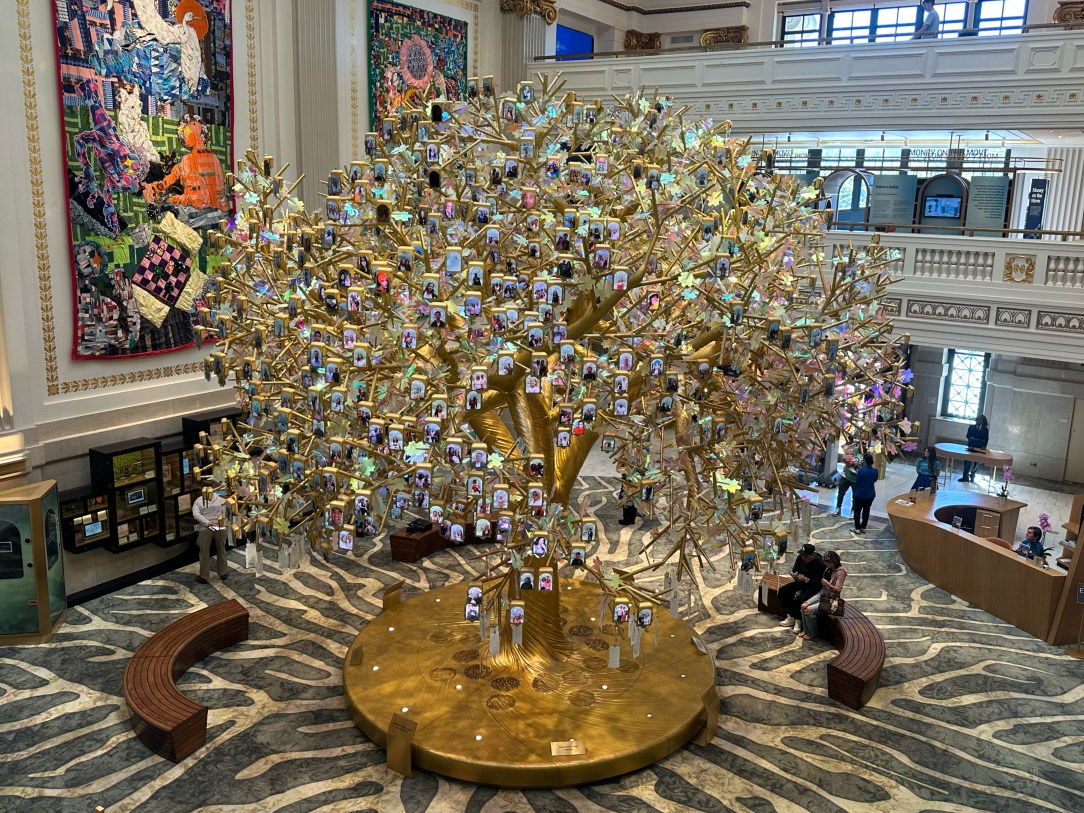
Inside, I was greeted by a glowing installation called the Tree of Generations that wanted my selfie before it wanted my story. I’m being diagnosed with capitalism at the door — vitals normal, spending habits terminal. A nearby screen scanned my aura and declared I was destined to become a “Future: Wealth Manager,” which is excellent news for someone who still calls her dad to calculate stock percentages for her stories. I can barely manage my vintage shoe habit, which my accountant (see: my dad) calls a depreciating asset, but it’s nice to know the algorithm believes in me.

The marble gleams. The ceilings soar. Every inch of this place has been designed to make you believe that ambition is a renewable resource. Upstairs, the old Riggs Bank vault has been reborn as a marble echo chamber of optimism. Abraham Lincoln’s hologram materializes to talk about a personal check he wrote to his son. Harry Truman boasts about learning “the worth of a hard-earned dollar.” I briefly checked Slack to confirm I was still earning mine. Downstairs, holograms of Serena Williams, Sanjay Gupta, Sal Khan, and Sara Blakely beam in to give entrepreneurial pep talks, like Peloton instructors for the free market. I tried to make eye contact with one of them before remembering they weren’t real — which, to be fair, is also how networking often feels in Washington.
The whole place hums with that gentle, omnipresent tone of self-improvement — the acoustics of a LinkedIn post. It’s an optimism museum built on the honor system: You pretend to believe, it pretends you can.
Every hallway is either a TED Talk you didn’t agree to attend or one that whispers gentle corporate reassurance. Your mindset fuels your dreams, one sign glows in bubble letters. True independence comes from being financially secure, says another. I again scrolled Slack to make sure I was still financially secure enough to be here on a weekday.
Then, I met Scoot.
Scoot is a small cartoon wheel who invites visitors to “follow their route to the American Dream” as part of a kid-friendly game — baby’s first dose of neoliberalism. The premise: You answer a series of questions about life choices, and Scoot grades your ability to achieve prosperity. It’s capitalism as a choose-your-own-adventure.
“What’s your goal?” Scoot asked. “Health, happiness, or wealth?”
I picked wealth. I wouldn’t swear to it, but I think Scoot smiled.
Career options: dog walker (low stress, low pay), ER surgeon (high stress, high pay), or freelance accountant (moderate both). I picked surgeon, because who doesn’t want to believe in upward mobility, even in a simulation. Scoot was thrilled — finally, a high earner in this economy. Housing came next: “Rent a modest apartment,” “Buy a bargain home with a long commute,” or “Get a big budget-busting house and take a second job to help pay for it.” I picked the last one. I think Scoot frowned. Then came the mortgage question — a 10-year or 30-year loan at 5%? I picked 30. Wrong. Even my digital alter ego can’t afford financial literacy.
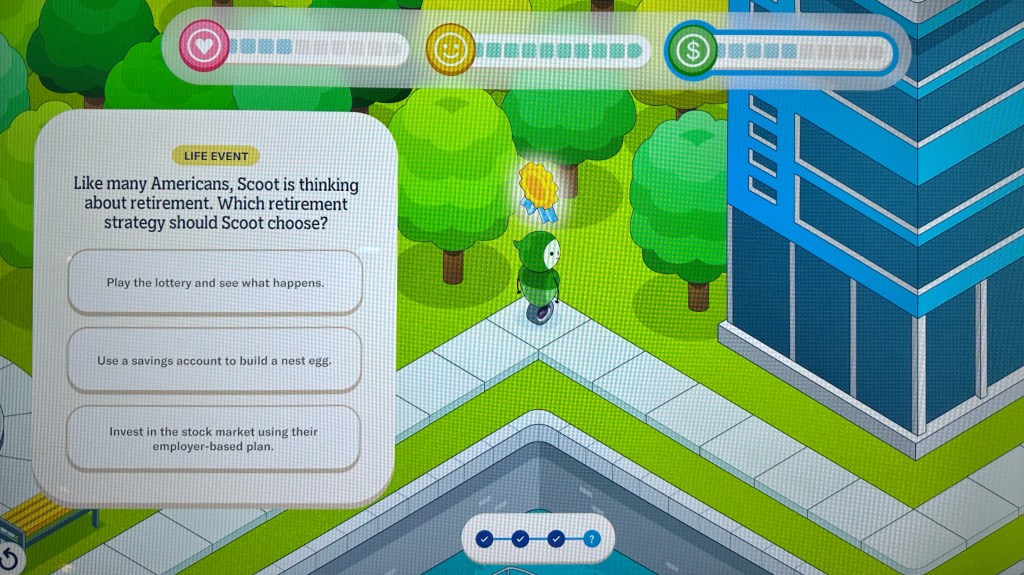
For relationships, Option B — “The world’s happiest marriage with two expensive kids” — was grayed out for me because of all of my bad decisions. Fitting. I chose “single and living in the moment,” which Scoot seemed to find acceptable. I guess even a surgeon’s income couldn’t survive my addiction to The Real Real; if capitalism is a religion, mine is headquartered in the pre-loved section. For retirement, I went with “play the lottery,” because, as someone who writes about the stock market and businesses for a living, I know a losing bet when I see one. (And because I know that the only way I’ll fulfill the dream of owning a brownstone in New York City is divine intervention and a GoFundMe). The screen chirped: “Scoot is rolling the dice on retirement.” My final score: 2/10 in Health, 9/10 in Happiness, and 2/10 in Wealth. I’d failed the American Dream, but at least I’d done so with good humor.
In another room, a father was teaching his three young daughters the mechanics of bond yields. They nodded like interns at a hedge fund. I envied their confidence; I was still trying to beat a cartoon wheel at capitalism. Next, I took to button-mashing through Portfolio Power Play, a stock-picking simulator that refused to reward random guessing. At this point, those girls could probably manage my Roth IRA better than I can.
Every display sells the same thesis: Prosperity is mostly about attitude. One sign reminds you that “entrepreneurs do it — so can you.” Another asks you to “discover your talents,” then quantifies them with unhelpful precision. Mine came out as 43% creative thinking, 29% influencing others, 14% relationship building, and 14% taking action. Which, if we’re being honest, explains both my career path and my perennial singleness.
Nearby, a display of classic board games — Monopoly, Life, The Landlord’s Game, Easy Money — reminded me that Americans have been beta-testing capitalism since the 1930s. The caption called them “Games of Risk and Reward,” which feels like an understatement. Monopoly aged into a metaphor, Life into a warning label, and The Landlord’s Game into a prophecy we ignored. Kids today play Roblox and Fortnite. Their grandparents played the stock market with dice.
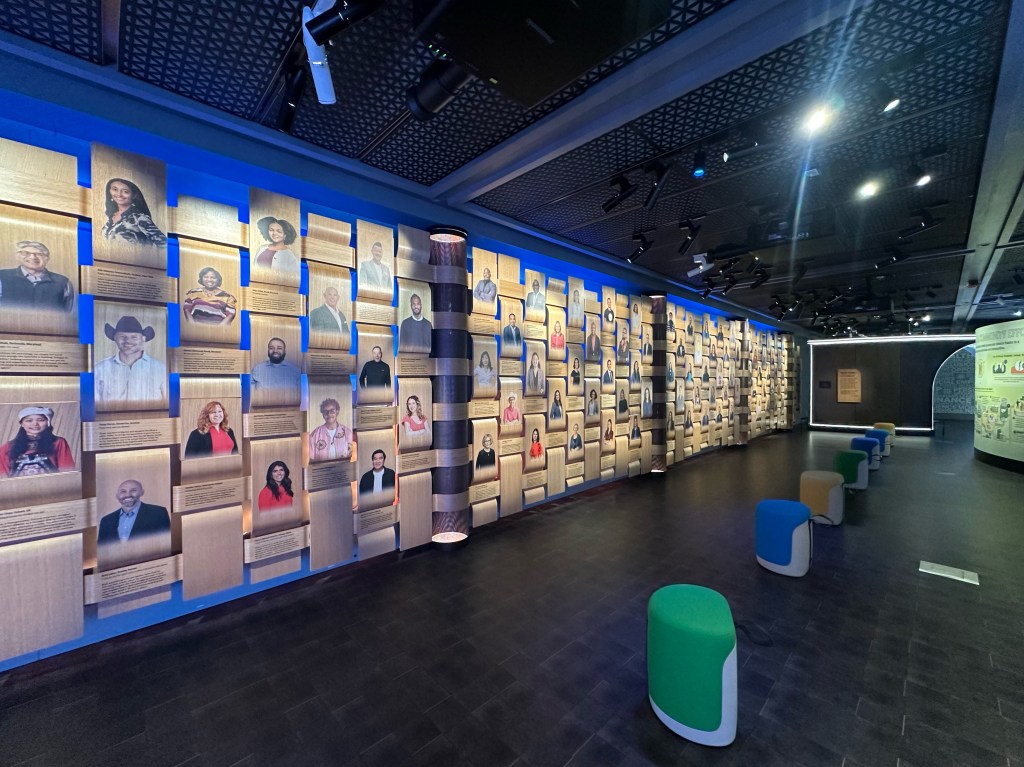
By the time I reached the Access to Capital gallery, I was knee-deep in optimism. Videos of finance executives explained venture capital, high-yield bonds, and futures trading, in the tone of a spa commercial. Hope had never been this well-lit. Then came a Rothy’s display — a red ballet flat in a glass case, an example of sustainable entrepreneurship through venture capital. I looked down. I was wearing the same pair. I’m not sure what it says about capitalism that my shoes are now an exhibit, but it can’t be good for my resale value. It’s one thing to see yourself in a museum; it’s another to realize your footwear has been absorbed into the case study.
If the American Dream has a pricing model, it’s freemium. Admission is free — belief should be accessible — but the best part still costs $15. That’s the ticketed “immersion theater,” a high-definition faith simulator that turns capitalism into content. It’s all very on-brand: The country that built microtransactions for dopamine has now built a museum for it. Fifteen dollars buys you the “you are there” moment — history stitched to serotonin, optimism rendered in surround sound. The experience mirrors the economy outside the museum’s doors: subscribe for meaning, paywall the catharsis. And I get it. I’ve paid more for worse feelings.
The museum itself is beautiful, which is part of the trap. It’s all marble vault doors and grandeur, a cathedral to confidence. You start to feel like success might be contagious if you breathe deeply enough. Suchitra Mattai’s “A Collective Horizon” glows on the stairwell, a rare bit of art that doesn’t try to motivate you. Then you turn go up a few flights of stairs and find George W. Bush’s exhibit on “Portraits of America’s Immigrants.” The brushwork is earnest; the timing, less so. A nearby sign announces that “since 1960, no progress has been made” in U.S. education and human capital — an oddly cheerless note in a room sponsored by billionaires.
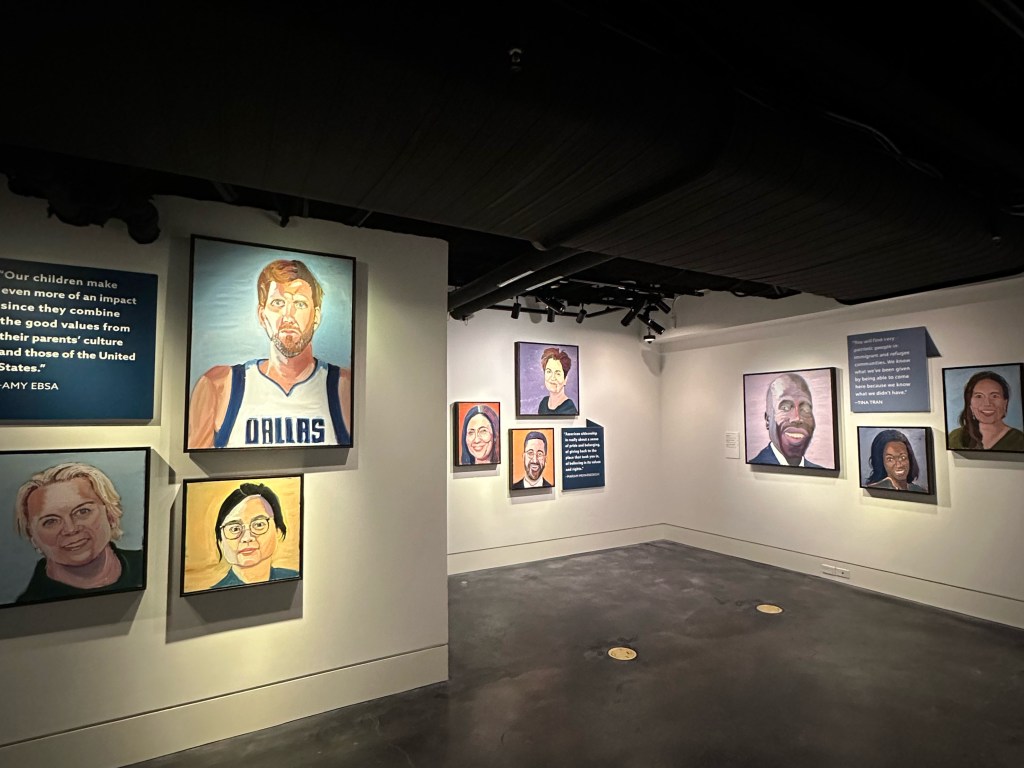
Somewhere between Lincoln’s checkbook and Bush’s oil-painted empathy, I realized I was standing inside a very expensive group project on optimism. Every voice in the place — the presidents, the CEOs, the holographic athletes — repeats the same promise: The system works, if you do. The museum’s tagline might as well be It’s not the market, it’s you.
Eventually, you reach the inevitable end: the gift shop.
The merchandise is a master class in mixed messaging. There are T-shirts embossed with “Right on the Money,” laminated “Prosperity Formula” charts, and Milken-branded travel mugs for anyone eager to store faith in stainless steel. The reading list is a choose-your-own-adventure of capitalism’s greatest hits, ranging from Alexis de Tocqueville’s “Democracy in America” to Charles Koch’s “Believe in People” to Ayn Rand’s “Atlas Shrugged,” which feels a bit like selling a hangover kit at a wine tasting. There are children’s books with titles such as “Why Did Grandpa Cry?” and “What If Higgins Had Given Up?” I considered buying a stuffed bald eagle, but I figured my 2/10 wealth score couldn’t justify the expense. I’d already spent my disposable income on happiness. I bought it anyway. Merry Christmas, Dad.
Outside, the shutdown continued. The National Guard still, well, guarded. ICE was still at the metro. My Slack still buzzed. The museum’s signs said the American Dream was alive, but the streets looked less convinced. Inside the Capitalism Museum, everything is interactive. Outside, everything is collateral. I thought about Scoot, my robotic, wheeled surgeon with the big house and the wrong mortgage, who gambled on the lottery and still scored a 9/10 in Happiness. Maybe that’s the real American Dream now: not success, but optimism with good production value.
I went to the Capitalism Museum, and all I got was a stuffed bald eagle — and the quiet reassurance that irony, at least, is still free. Maybe the American Dream is running on store credit.
This article first appeared here.
 shannonigans